Melissa M. Cybulski, Longmeadow Historical Society
Published in Longmeadow Neighbors | November 2026

The Apple Visionary’s Time in Town
Is it true? Was he really from here? Or is it just part of local folklore? It is often mentioned that Johnny Appleseed lived in Longmeadow. His story is frequently included in 3rd grade curriculum in the Longmeadow schools. But … really? After combing through our boxes, shelves, folders and files in the archives of The Longmeadow Historical Society at the Storrs House Museum, it is fair to say …
Yes! He has been found - in a shopkeeper’s daybook as a young boy receiving a delivery of rum and sugar for his father in 1781. At the time of this daybook entry by a town shopkeeper, Johnny Chapman would have been approximately 7 years old. As Capt. Nathaniel Chapman’s only boy at that time, this must indeed be little Johnny “Appleseed” Chapman.
In brief, Johnny Appleseed was born John Chapman in Leominster, MA in September, 1774 - just months before the famous “shot heard round the world” formally began the American Revolution. His father was a minuteman. Young Johnny’s mother died two years later from complications due to childbirth. That baby died as well. Capt. Nathaniel Chapman began service at the new Springfield Arsenal soon after, presumably leaving his young son and an older daughter behind to be cared for by his deceased wife’s family.
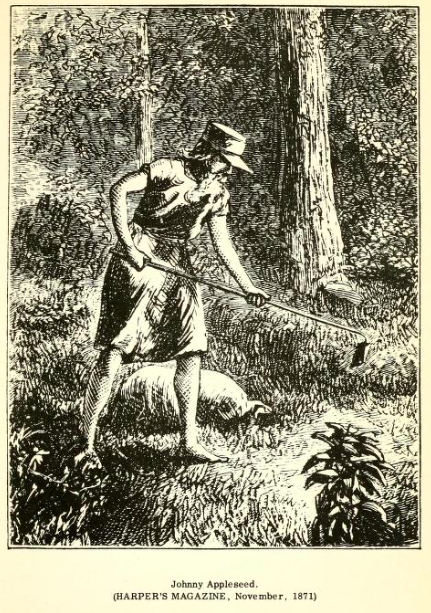
In July of 1780, Capt Chapman took a Longmeadow bride, 18 year old Lucy Cooley. Soon after, Capt. Chapman was relieved of his duties at the Springfield Arsenal and settled into life in this town. A big question has always been whether his son, Johnny, ever joined him out here in Longmeadow. The above daybook entry appears to confirm he did. The scant records available indicate that the Chapmans were never wealthy, and what they lacked in quantity of land or money, they made up for in quantity of children - 10 were born between 1781 and 1803. Certainly this made lean times even leaner for young Johnny Appleseed’s family. Recently uncovered Longmeadow records seem to indicate that Capt. Chapman served time in a debtor’s prison as well in 1785.
Account Books from Col. Jonathan Hale, Esq., a Longmeadow selectman and shopkeeper, record many visits to his store from Capt. Nathaniel Chapman where he purchased items like rum (no, not cider), sugar, molasses, coffee, tobacco, turnips, salt and nails. Chapman generally appeared to pay for these goods through bartered labor. Tax records indicate that Capt. Chapman was a man of so few means that there was almost nothing to tax for him. He owned no property and the house the family reportedly occupied was an old, old house on Cooley land owned by his wife’s family.
It is believed the Chapman’s settled into a small house built c.1695 on land owned by Lucy’s family. While today the house still sits on Fairfield Terrace, at the time the Chapman’s lived there it was believed to have been somewhere about 2 miles south of Springfield on the hill leading down towards the meadows and Connecticut River. Drive by it sometime and just try to imagine 13 people - 11 of them children - existing comfortably. Not hard to see why Johnny left for wider pastures.
Johnny Chapman likely lived in Longmeadow from ages 6-16, and maybe even a handful of years beyond that. No one knows for sure when he left his family here behind to start his journey west to begin his life of philanthropic apple seeding. However, it is exciting to know that a figure of such legendary status in American folklore spent his formative years in our midst.
What was life like for Johnny “Appleseed” Chapman in Longmeadow from 1780-1790? Well, that has been quite exciting to piece together. It was a remarkable period of growth and change in our town and nation. Stay tuned for part two of Young Johnny Chapman’s Life in Longmeadow next month in Longmeadow Neighbors.
Other Articles from this Issue…